Cirrial
DIV_BY_ZERO (Admin)

Old Friend

Power Apathy Party


Posts: 672
|
 Posted: Thu Feb 14, 2008 5:15 am Post subject: [Species] Serai Posted: Thu Feb 14, 2008 5:15 am Post subject: [Species] Serai |
 |
|
ENCYCLOPAEDIA AETHERIA
"In Knowledge, Freedom"
Est. 2076
XXVIII. THE SERAI
Who are the serai?
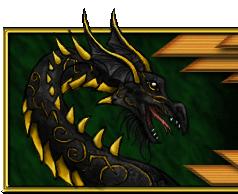
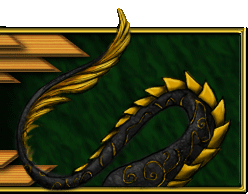
We know the serai to be beings not from this universe. In appearance, they are long, slim, and anguine, with six tendrils for arms, tapering to points, and any number of tendrils protruding from their backs.
Their bodies taper to a point. Whereas their arms are under conscious control, it appears to us that their back tendrils are subconciously controlled, flailing when the serai feels strong emotions. Their bodies are black and smooth. The records we have of the feel of a serai body are limited, but hint towards them feeling almost frictionless, warm, and deformable to the extent of flesh, but with slightly more resistance. Their heads have two long angular ears, which deform much as their tendrils do, a long tapered snout with no evidence of a mouth, and shining yellow eyes with broad, circular white pupils.
Humans, keynain[1] and saa-kru[2] don't detect any strong odours, apart from a faint trace of sterile cold air on objects a serai has phased through. However, keletians[3] specifically smell something they describe as having properties of void, or vacuum. Considering that vacuum, by its very definition, has no scent, we can assume this to be the best translation of an untranslatable gestalt only the keletians can sense.
It has also been postulated that, due to the fact the serai are extrauniversal in origin, the serai emit an energy similar (but with subtle differences) to the mind energies a keletian stores, and that the keletians detect this change as an olefactory one.
The laws of physics in the serai universe are unknown. However, in our universe, they can defy gravity, although not with the ease we once thought them to possess. Injured serai will often fall to the ground, and only foolish serai suspend themselves higher than a couple of metres above ground. However, given the amount of tendrils a serai possesses, they can move on ground, but not with the elegance and poise they would desire.
Additionally, regardless of their laws of physics, the serai are very good at violating one of our own - the law dictating that matter cannot occupy the same space as other matter (although this is heavily disputed by Maratix, the entity responsible for the infamous "Three-Places-At-Once" marketing campaign). The serai can pass through solid matter as if it were air, but current data indicates this takes a large amount of effort on the individual. In fact, some rare instances have been recorded of them getting stuck in thick walls and perishing from either asphyxiation or starvation, and slightly more common are the tales of serai flying through a wall to escape a pursuer, only to become exhausted by its actions and collapse onto the ground.
It has been theorised that the serai manage to temporarily transmute into a semi-gaseous state. This explains why they can't pass through airtight barriers, but does not explain how a living organism can alter its chemical state and return to normal, nor maintain sapience in the process. However, the ill-defined theory of conscious cohesion has been offered as an explanation for the latter.[4]
It is the frequent mistakes that seem to be more and more commonplace by individual serai that have greatly contributed to our understanding of them. Not as monsters from another plane, nor as the manifestations of mindsets too alien to comprehend, not even as cold, distant observers. Rather as a species not unlike our own. A species of individuals with flaws and strengths.
Why do they come here?
Why do we go anywhere? A sophont of any species will contemplate its own existance and its place in the universe. Some will restrict their universe to smaller boundries. Some will travel beyond the stars and into the tangle of dimensions inconcievable to our minds. They originally came here as explorers, as curious as any thinker, always craving new intellectual stimuli to ponder.
Why do they keep coming back here?
Because this universe allows them certain benefits over others, apparently. Or perhaps they visit many other universes than ours frequently. The Melesi have mentioned serai encounters, but with visits nowhere near as frequent as in our own universe.
They come back here to steal others. They take sophonts and, through a process we still aren't even close to comprehending, convert, or assimilate, or just simply change them into a serai. We don't know if they keep their own memories, their own minds, their own personalities. We don't even know if there are arrangements made beforehand or if they're taken by force.
But knowing why they do it makes us a little more symptathetic. In fact, more and more actually volunteer themselves to be the willing targets of this serai process.
So why do they do it?
First, a lesson about the overall history of the entire the serai is required.
The serai have been a curious species. We don't know their exact composition, but we're willing to say they're the remnants of a different culture. We don't believe they arose from nothing. They may be the result of their progenitors' singularity. Whether they have replaced them or exist alongside them, we have no idea.
The reason we give this hypothesis is due to the support the serai themselves have for it. Their most ancient tomes hint at a creator species behind them, and the serai are not a species predisposed to religion. The serai do not seem at all concerned about their creators, and never mention them even if prompted.
However, due to this construct nature, there were some aspects that their theoretical creators either did not imagine ever to occur, were not able to account for, or deliberately engineered into the serai.
They value the lives of other serai to an extent that may be greater than the akari[5] value for life in general. Given that the akari are an oft-cited example of an existing Asimov Group[6] species, this may lead one to believe that the serai are also an Asimov Group species. While they display tendacies of this nature, they aren't a true Asimov Group, as the individual serai will always value its life above all else.
Their culture and history has been mostly war free, with their last war over millenia ago. Their governments have been short-lived, and they live mostly egalitarian. Their sense of ownership over property is stronger than that of the akari, but not nearly as strong as, say, a saa-kru, human, keletian or keynain.
The serai treat their property as we would treat works and goods under a public domain, free for anyone to use. This is most likely due to the nature of their technology and property - the materials they use are so mutable and protean, they can literally tear something in half and form two near-perfect copies of the same object.
But this is a digression. The main point intended is that the serai all eventually work to one aim, not through government or through hierarchies, but through emergence. Serai are highly social, as evidenced by the fact not one serai has appeared unaccompanied by others, but usually in groups of four or five.
And for the longest time, and still now, one of their most pressing concerns has been the aversion of an either intentional or unintentional flaw in the serai organism. They seem to be unable to procreate, which seems strange, given the ease every other organism in our known universe has concerning this matter.
As a result, from the moment they came into existance through whatever origins, the serai have been slowly dying out.
Their value for life not only stems from instinct, but from fear that the serai species will die. They delve into other universes and are terrified if anyone in their group's fate is uncertain. They can glide onto stations with absolute calm and become broken, hysterical emotional wrecks if one of their kind is so much as scratched badly.
And so their primary technological direction has been, for thousands upon thousands of years, trying to prevent species extinction from happening. The fact that the serai have almost limitless lifespans, becoming pseudo-immortal, is one that has arisen as a temporary solution to the problem of extinction.
The serai have tried everything. Growing serai in vats, manipulation of their biological selves, building new serai out of artificial materials, and recently, converting other sophonts into serai in the hopes they can provide answers, either with their minds or bodies.
Unfortunately, their disorganised nature makes their works less efficient as they could be, with redundant research and conflicts of interest hindering their efforts. Another problem realised by the serai is that, despite their biological nature, they appear to possess an unwieldly amount of potential genders, with no obvious biological or mental signs indicating the gender any given individual can be. No individual can identify their own gender, and so it is a serai tradition to refer to any and all serai as genderless.
It is reputed that there was once a text, akin to an ancient instructional manual, detailing the complex process of identifying serai genders and the requisite series of combinations required to produce a new serai, to be gestated by a member of the gestation gender, but this text is so heavily damaged and corrupted that all the serai can identify are gestation individuals.
Over five thousand years, there have been exactly two serai pregnancies, which were both revealed to be unstable and lead to the serai young dying soon after birth, and were both the results of completely different sequences. Both failures sent almost the entire serai species into near catatonic depression.
Given this debilitating condition for a species to have, it is no wonder that certain sophonts volunteer to be converted into serai, to help the species that we have long viewed with hostile eyes to survive.
---
Explanations:
1. The keynain are a bipedal avian species, and a member-species of the Floating Arm alliance.
2. The saa-kru are a quadrupedal semi-insectoid species, and a member-species of the Floating Arm alliance.
3. The keletians are a bipedal vulpine species, and a member-species of the Floating Arm alliance.
4. Conscious cohesion is the name given to the theoretical process that the act of thinking holds matter together, and that all minds can control matter to varying degrees, although most minds are too weak to have any noticable effects. Conscious cohesion is a popular explanation for how Melesian elementals are able to both stay together and exert control on their own element from distances.
5. The akari are a semi-reptilian species and are a neutral non-spacefaring species.
6. An Asimov Group species is defined as one where all individuals of said species place greater regard on the lives of those around them than their own lives. It is theorised that a true Asimov Group species is impossible, as survival depends upon some degree of self-preservation.
For more detailed explanations and discussion, please consult the appropriate sections of the Encyclopaedia Aetheria.
((Obligatory picture!))
_________________
This is a signature that states a new signature shall be coming at some point in the future. The purpose of this signature is to indicate its own foretold demise. Sometimes, having a purpose is not always a good thing. |
|